
RV TOWING, WEIGHT & SAFETY · FREE PLANNING TOOL
RV Towing Capacity & Payload Calculator
Understand the limits behind your next adventure.
Not sure whether your truck or SUV can tow a travel trailer? Our free RV towing calculator compares trailer weight, vehicle payload, tongue weight and manufacturer towing limits to help identify potential weight-rating problems before you tow.

QUICK ANSWER
You need more than a maximum tow rating. Available payload, whole loaded trailer weight, tongue or pin load, GVWR, GCWR, axle, tire and hitch limits all matter. The lowest applicable limit can restrict your setup.
Where to find manufacturer ratings →YOUR VEHICLE. YOUR LOAD. YOUR LIMITS.
Calculate Your RV Towing Capacity
Start with known weights. Blank fields are unknown. Simple mode gives preliminary checks; add ratings and measurements in Advanced mode for a fuller assessment. All entered information is user supplied.
Loading calculator… If this notice remains, reload the page or contact the site owner. Inputs stay disabled until the calculator is ready.
No current calculated assessment. Recalculate before relying on printed results.
WEIGHT-RATING ASSESSMENT
See how the scale weights reconcile
Load vs rating
Signed margin = rating − load. Comparisons use unrounded values. Bars fill at 100% of the rating; overload amounts remain visible in the table.
| Check / basis | Load | Rating | Margin | Use / status |
|---|
Missing information & next actions
Inputs & measurement basis for this assessment
Keep or compare your configurations
Save on this browser only. No account or calculator data transmission. Two comparison snapshots are kept in this tab; resetting inputs retains snapshots and browser saves. Delete them separately.
RV towing measurement and safety gear
Optional equipment to compare for your RV setup.
Affiliate disclosure: This section contains paid Amazon affiliate links. As an Amazon Associate I earn from qualifying purchases.
Trailer tongue weight scale
Measure loaded tongue weight within the scale rating.
Check for the latest price →Trailer brake controller
Compare compatible trailer-braking controls.
Check for the latest price →Heavy-duty wheel chocks
Secure wheels when parked on suitable surfaces.
Check for the latest price →As an Amazon Associate I earn from qualifying purchases. These are sponsored affiliate links. Product specifications and availability can change. Measurements and tools do not establish equipment safety; always follow manufacturer instructions, applicable electrical and plumbing requirements, and qualified-professional procedures.
Understanding Your Towing Results
Exceeded Limit means at least one supplied rating is below the corresponding load. An estimated overload is preliminary, but still needs attention. Cannot Fully Assess means a rating, measurement or setup confirmation is missing or inconsistent. Within Checked Limits describes complete, user-supplied data checks only; it is not a safety certification.
Each bar compares a load with its own rating. A zero margin is exactly at the rating. The most-utilized rating is the primary limiting factor among checked ratings; its margin is not a universal allowance for more trailer weight. An unknown component may be more restrictive.
How Much Can My Truck Tow?
Start with the towing guide for your exact vehicle configuration: model year, engine, axle ratio, cab, bed, driveline and factory towing equipment. Confirm any passenger or cargo adjustments required by that guide. A brochure maximum for a different configuration is not your rating.
Then compare the loaded trailer with that rating, check truck payload and axle loads, and check combined weight and every applicable hitch limit. A 7,000 lb trailer may fit a tow rating while overloading payload or the rear axle.
Towing Capacity vs Payload Capacity
Tow rating limits the trailer being pulled. Payload limits the occupants and cargo carried by the truck, including applicable trailer tongue or fifth-wheel pin load and added equipment. They measure different load paths.
Worked example, not a vehicle recommendation: 1,800 lb sticker payload − 1,050 lb people/cargo/equipment − 900 lb tongue weight = −150 lb remaining payload. Even a 10,000 lb tow rating does not resolve this overload. The sticker roster is a separate cross-check; do not add those loads again to an already loaded scale weight.
Understanding GVWR, GCWR and Axle Ratings
GVWR is the maximum loaded weight of a vehicle. GCWR is the maximum combined vehicle-and-trailer weight. GAWR is the limit for one axle. Find GVWR and GAWR on the vehicle certification label; find GCWR and the correct tow rating in manufacturer documentation for the exact configuration.
Trailer GVWR covers the whole loaded trailer. Tire capacity depends on the tire and applicable load/inflation instructions. Even an axle within GAWR can overload a tire on one side. Check individual wheel positions; do not divide tandem axle totals equally to establish compliance.
Hitch ratings apply to the receiver, ball mount, ball, coupler or fifth-wheel system as applicable. Check gross trailer and vertical load ratings for the actual operating mode. Use the lowest applicable component, and resolve unknowns before towing.
How Tongue Weight Affects Towing Capacity
Tongue weight is the downward load a conventional trailer applies at the hitch. Pin weight is the vertical load from a fifth-wheel trailer. Both affect vehicle loading. A low load is not automatically acceptable: follow the manufacturer’s minimums, loading balance and setup instructions as well as maximums.
How do you determine tongue weight of a trailer?
Use suitable tongue-weight equipment or a manufacturer-approved scale procedure with the trailer loaded for travel. Connected truck axle-weight change with WD engaged is not necessarily the raw tongue load. The percentage option here is an explicitly entered planning assumption, not a measurement or a recommended range.
Travel Trailer vs Fifth-Wheel Towing
A conventional trailer couples behind the truck; a fifth-wheel couples in the bed. Their vertical loads and axle effects differ. Select the correct connection to check the appropriate hitch components. This calculator does not apply conventional tongue assumptions to fifth-wheel pin weight.
A weight-distribution hitch changes axle loading; it does not automatically increase manufacturer ratings. Measure the connected axles with the actual setup. No fixed load-transfer percentage is assumed here.
How to Verify Your Vehicle and Trailer Weights
- Record the exact vehicle, trailer, hitch-component and tire ratings from labels and manufacturer instructions.
- Load people, fuel, cargo, fluids and equipment as for the trip. Weigh the loaded truck alone, including truck-mounted hitch hardware.
- Connect the loaded trailer using the actual setup and weigh the truck front axle, truck rear axle and each trailer axle. Obtain wheel-position weights for tire checks.
- Measure tongue or pin weight using an appropriate method. Keep the loading consistent between tickets.
- Reconcile the totals and review every margin, including any manufacturer-required reserve or restrictions.
Accounting example: truck alone 6,000 lb + whole trailer 7,000 lb = combined 13,000 lb. With WD, a connected truck total of 6,750 lb and trailer axle total of 6,250 lb also equals 13,000 lb. Adding 6,750 + 7,000 would count hitch-supported load twice. The 750 lb truck-total change is not a measured tongue weight.
Dry weight excludes some trip loads and equipment. In estimate mode, enter only added masses absent from that dry baseline. Measured whole-trailer mode disables those additions to prevent double counting. The adjustable reconciliation tolerance defaults to 5 lb and is for scale diagnostics only; it never increases a rating. Deriving a whole-trailer weight uses connected truck axles + trailer axles − truck alone, with the same loading on every ticket.
Common RV Towing Mistakes
- Using advertised dry weight as the loaded trailer weight.
- Checking only tow rating while ignoring payload, axles or hitch components.
- Adding people, cargo, tongue load or fluids a second time to weights that already include them.
- Treating a blank rating as unlimited, or a generic tongue percentage as approval.
- Assuming WD increases ratings or that a combined axle total establishes individual tire loading.
RV Towing Capacity Calculator FAQs
How do I calculate my RV towing capacity?
Use your exact-configuration manufacturer tow rating, then check loaded trailer weight, payload, GVWR, GCWR, axle, hitch and tire limits. This calculator compares supplied loads and ratings; it does not look up vehicle specifications.
Can my truck tow a 7,000-pound travel trailer?
That weight alone cannot answer the question. You need the whole loaded trailer weight, exact truck ratings, tongue or pin load, people and cargo loads, connected axle measurements and equipment ratings.
What is the difference between towing capacity and payload?
Towing capacity concerns trailer weight being pulled. Payload concerns load carried by the truck, including occupants, cargo, added equipment and applicable tongue or pin load.
Does trailer tongue weight count against payload?
Yes, account for the applicable full tongue or pin load under manufacturer loading instructions. WD does not provide an automatic payload credit.
How do I find my vehicle’s GVWR and GCWR?
Read GVWR and axle ratings on the vehicle certification label. Use the manufacturer towing guide or exact-vehicle documentation for GCWR and tow rating. The payload label is vehicle specific.
Can I tow a trailer that weighs less than my maximum tow rating?
Being below tow rating is one check. Payload, axle, GVWR, GCWR, hitch, tires and other setup requirements can still be exceeded.
How do I calculate loaded trailer weight?
Weigh the whole loaded trailer, including its hitch-supported load, or derive it from matched connected truck and trailer axle tickets minus the loaded truck-alone weight. Dry weight plus additions is preliminary.
Is fifth-wheel towing different from travel trailer towing?
Yes. Pin load is applied through the bed-mounted hitch and has different vehicle-loading effects. Use fifth-wheel and pin-box ratings and measured connected axle loads.
Does a weight-distribution hitch increase towing capacity?
It redistributes load and may be required for a manufacturer-approved setup. It does not automatically raise vehicle GVWR, GCWR, payload or tow rating. Follow the ratings for the actual approved hitch mode.
How can I weigh my vehicle and trailer accurately?
Use suitable certified scales and manufacturer procedures with consistent trip loading. Obtain individual axle and wheel-position readings where needed and measure tongue or pin load separately.
Can I calculate RV towing capacity in kilograms?
Yes. Switching units converts entered mass values using 1 lb = 0.45359237 kg. Unknown fields stay blank. The percentage field is dimensionless.
What should I do if my weight ratings are exceeded?
Do not use the result as permission to tow. Reduce or redistribute loads only as allowed by the manufacturer, change equipment or vehicle as needed, and reweigh. Resolve every exceeded or missing check with qualified assistance.
Next Steps
Review the full purchase decision with the tools below. Each calculator keeps separate inputs; values are not transferred automatically.
Related RV Calculators & Planning Tools

RV Pre-Purchase Inspection Checklist
Record condition findings and repair estimates.

RV Buying Decision Planner
Review finances, unresolved checks and purchase assumptions.
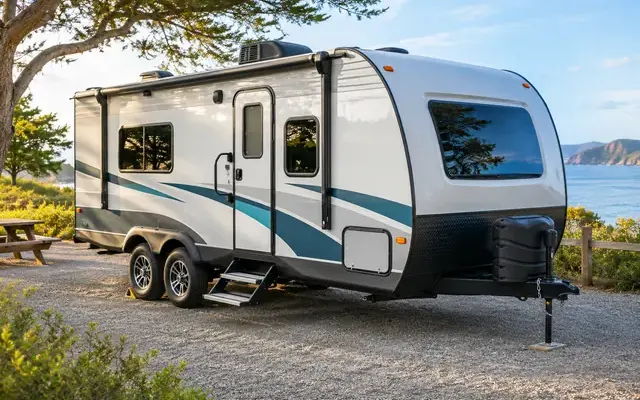
RV Cost of Ownership Calculator
Plan the costs of your trailer and ownership scenario.
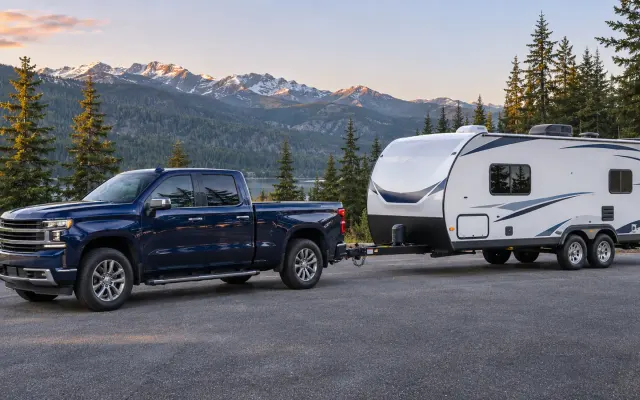
RV Trip Budget and Planning Tools
Estimate trip spending using your own fuel assumptions.
Manufacturer resources & calculation notes
Consult the Ford towing guides for vehicle-specific documentation and CURT’s towing-capacity measurement guide for terminology. These sources do not endorse this calculator or its illustrative values. Reviewed November 5, 2026.
Calculations run in your browser. No vehicle lookup or automatic manufacturer verification. Measure again whenever loading or equipment changes.