
RV Buying & Financing • Buyer Tools
RV Pre-Purchase Inspection Checklist & Repair Cost Estimator
Buying a used travel trailer, fifth wheel or motorhome? Inspect the RV, record defects, estimate possible repair expenses and prepare a buyer report before committing to the purchase.
A low asking price is not always a bargain. Water intrusion, aging tires, appliances, title problems and electrical defects can change the real cost and risk of ownership.
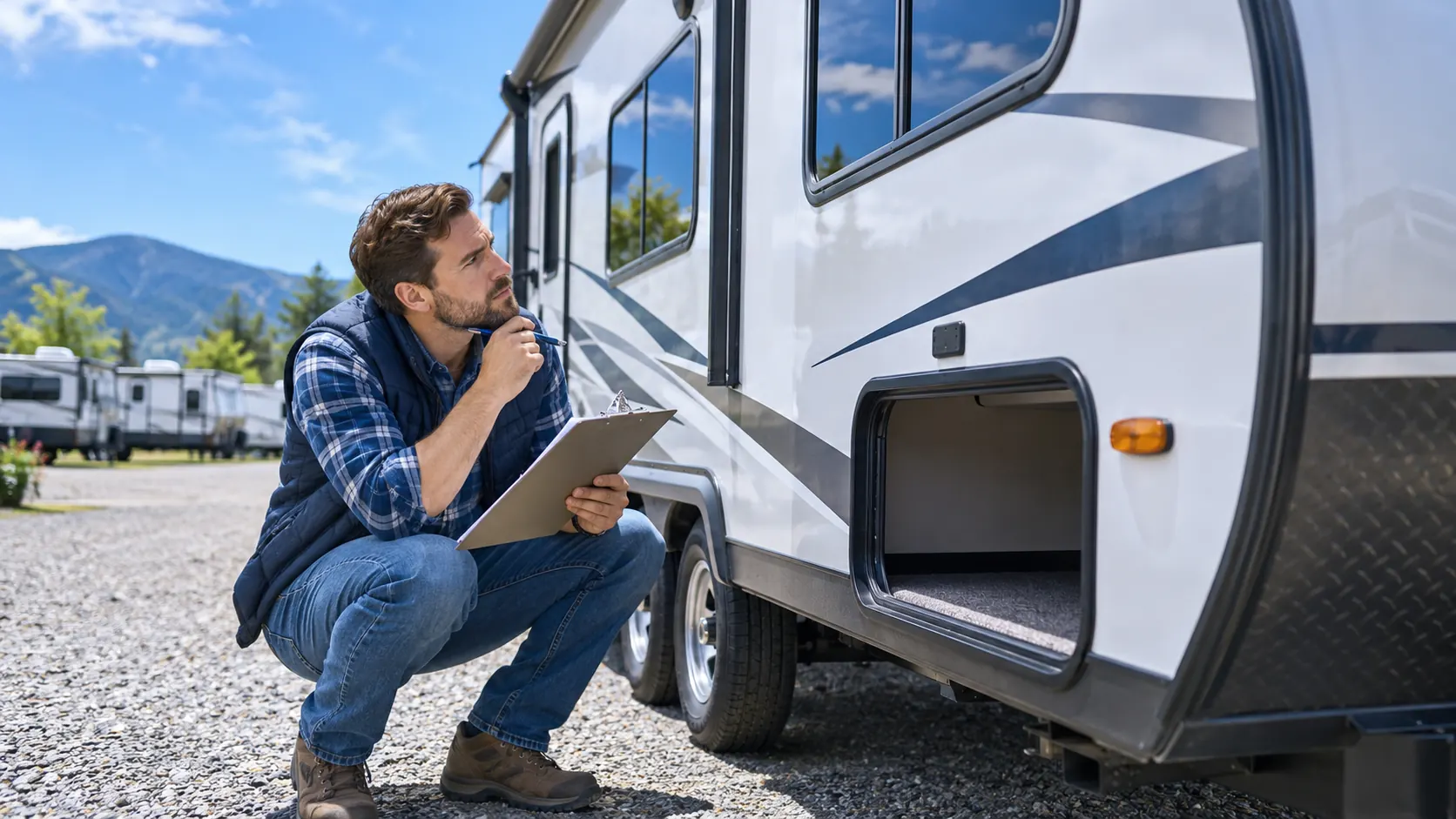
Quick Answer: What Should You Inspect Before Buying an RV?
Check the roof and seals, evidence of water damage, walls and floors, running gear, tires, brakes, electrical and plumbing systems, propane components, appliances, safety equipment and ownership documentation. Verify significant defects with qualified professionals and obtain written repair estimates. A buyer checklist cannot certify that an RV is safe.
Free Interactive RV Inspection Checklist
Use Simple Mode for essential checks and Advanced Mode for additional systems. Record Pass, Concern, Fail or Not Applicable for every item. The dashboard includes findings from both modes, including hidden advanced-mode safety warnings.
RVLifeKit • Calculator #005
RV Inspection & Repair Cost Planner
Inspect first. Record concerns. Evaluate your purchase.
Currency selection does not perform exchange-rate conversion. Values are held in the browser page and are not uploaded by this tool.
Repair Cost Planning
For each Concern or Fail, enter a low and high repair estimate. Blank means unknown, not zero. Use independent written quotes when possible.
Buyer Decision Dashboard
Findings
A Pass is a recorded buyer observation—not professional clearance. N/A is not a pass. Hidden defects, uninspected systems, ownership issues and unpriced repairs may remain. Neither this tool nor a low defect count certifies safety.
Advanced Repair Quotes & Buying Decision
Use the detailed checklist above as the inspection record. The optional itemized estimates below can be compared with its low/high ranges. Buying calculations are withheld for unverified safety findings, unchecked items, missing quotes, and invalid costs.
The existing “Other Purchase Costs” field is still used in the original dashboard. In the buying model below, it is treated as a separate unspecified expense; do not repeat that amount under “Other fixed fees.” Taxes are calculated separately on purchase price. Seller credits reduce cash outlay, not tax basis; confirm local tax treatment.
Itemized repair estimates (optional)
For each currently reported concern/failure, enter all four values, including explicit zeros. Labor = hours × hourly rate. These are compared to—not substituted for—the existing low/high repair estimates. A mismatched quote requires review.
An offer is a mathematical illustration, not purchase advice. The result cannot establish that an RV is safe, legal to transfer, or fairly priced. Resolve safety/ownership flags and obtain professional written quotations before purchase.
Local saving is optional. Data, including any VIN you enter, is stored unencrypted in this browser only; do not save sensitive vehicle details on shared devices.
Download or print your report before leaving this page unless you have chosen Save locally.
RV inspection equipment
Optional equipment to compare for your RV setup.
Affiliate disclosure: This section contains paid Amazon affiliate links. As an Amazon Associate I earn from qualifying purchases.
Pinless moisture meter
Screen accessible wall and floor surfaces for moisture.
Check for the latest price →Telescoping inspection mirror
See into accessible hard-to-reach areas.
Check for the latest price →Outlet circuit tester
Check supported receptacles; use qualified help for electrical faults.
Check for the latest price →As an Amazon Associate I earn from qualifying purchases. These are sponsored affiliate links. Product specifications and availability can change. Measurements and tools do not establish equipment safety; always follow manufacturer instructions, applicable electrical and plumbing requirements, and qualified-professional procedures.
How to Interpret Your Inspection Results
Inspection coverage
Coverage measures applicable checklist items marked Pass, Concern or Fail. Unchecked and N/A entries are not treated as inspected.
Recorded concerns and failures
These findings need further evaluation. A potential defect may require a written quotation or specialist investigation.
Safety flags
Safety-related concerns take priority regardless of completion percentage or repair estimates. Do not interpret a high coverage figure as a safety clearance.
Cost exposure
Only entered repair estimates can be calculated. Missing prices produce a partial or incomplete estimate, never a false complete total.
How the RV Repair Cost Estimate Works
For each recorded issue, enter minimum and maximum expected repair expenses in your chosen currency. Apply a contingency to account for uncertainty. Compare the resulting repair range to the asking price and any additional purchase costs.
For example, estimated repairs of $1,550–$2,550 with a 15% contingency produce a repair range of $1,782.50–$2,932.50. These estimates are illustrative and are not quotations. If a required estimate is missing, the complete purchase cost remains unavailable.
Worked example: buying a used travel trailer
| Item | Illustrative cost (USD) |
|---|---|
| RV asking price | $35,000 |
| Tire replacement | $900–$1,300 |
| Roof seal repairs | $400–$800 |
| Battery replacement | $250–$450 |
| Total repairs, before contingency | $1,550–$2,550 |
| Repairs plus 15% contingency | $1,782.50–$2,932.50 |
| Other purchase costs (assumed) | $1,000 |
| Asking price + fees + estimated repairs | $37,782.50–$38,932.50 |
The example excludes financing interest, future ownership costs and any concealed or unquoted defects.
10 Important Areas to Inspect Before Buying a Used RV
1. Roof and exterior seals
Check visible membrane damage, penetrations, sealing and window or door joints for possible entry points for water.
2. Moisture, mold and soft floors
Look for staining, odors, delamination and movement. Hidden water damage may require specialist assessment.
3. Tires, brakes and suspension
Investigate tire age and loading, brakes, bearings, axles and tow or chassis equipment as applicable.
4. Electrical and batteries
Inspect visible connectors, batteries, shore power and protection equipment; leave energized tests to competent professionals.
5. Plumbing and tanks
Check leaks, pumps, water heater, drains and wastewater plumbing without forcing unsafe operation.
6. Propane and fire protection
Have questionable gas components professionally checked. Confirm alarms, extinguishers and emergency exits.
7. Appliances and HVAC
Check refrigeration, heating, cooling, cooking equipment and their operating condition.
8. Slide-outs and awnings
Inspect visible seals, alignment, movement, water damage and mechanical condition.
9. Engine and motorhome chassis
For motorhomes, obtain appropriate engine, steering, drivetrain, suspension and brake inspections.
10. Title, VIN and records
Verify seller authority, VIN, lien information, applicable records, recalls and maintenance history.
Warning Signs That Deserve More Investigation
| Finding | Possible risk | Next action |
|---|---|---|
| Soft floors or extensive stains | Structural or hidden moisture damage | Independent investigation |
| Damaged propane equipment | Fire, explosion or gas exposure | Qualified gas inspection |
| Overheated or altered wiring | Shock or fire hazard | Qualified electrical inspection |
| Aged or damaged tires | Roadworthiness concern | Professional tire evaluation |
| Ownership or lien uncertainty | Legal or financial exposure | Verify before paying |
| Seller refuses reasonable inspection | Unresolved condition risk | Consider walking away |
How to Use the RV Inspection Checklist
- Select RV type, currency, year and asking price.
- Complete Simple Mode essential buyer checks.
- Open Advanced Mode for the complete applicable checklist.
- Document defects with notes and repair-cost ranges.
- Review safety flags, unchecked items and missing costs.
- Print or export the report and obtain independent professional verification before deciding whether to buy.
How to Decide: Negotiate, Request Repairs or Walk Away
Document and verify
Finish applicable inspection checks, substantiate any Not Applicable answers, and request independent estimates for every concern or failure.
Compare true acquisition costs
Use low/high repair quotes, contingency, taxes, inspection charges, fees and seller credits. A low price can still exceed your available budget.
Compare with reliable market evidence
Use comparable RV listings or an appraisal with matching year, condition, floorplan and location. Market value is never generated automatically.
Walk away from unresolved critical risks
Propane, brakes, electrical, structural integrity, serious water damage and unverified ownership require qualified resolution. A discount does not make an unsafe RV safe.
When Should You Hire a Professional RV Inspector?
Consider an independent inspection for any substantial used RV purchase, especially older vehicles, unclear histories, suspected moisture damage, safety-related failures or high repair uncertainty. Confirm the inspection scope and exclusions. Motorhomes can require separate automotive and habitation assessments.
Negotiating After an Inspection
Record defects, obtain written repair quotations, and compare the full acquisition cost with alternative RVs. The calculated repair amount is a negotiation reference, not a guaranteed price reduction. Some defects justify walking away rather than accepting a lower price.
RV Pre-Purchase Inspection FAQs
What should I check before buying a used RV?
Inspect roof, seals, visible moisture damage, floors, tires, brakes, electrical, plumbing, propane, appliances and documentation. Use professionals for hidden or safety-critical issues.
Can I inspect an RV myself?
You can perform a preliminary visual inspection and document concerns. It does not substitute for specialist tests and cannot rule out concealed defects.
How do I recognize RV water damage?
Signs can include soft floors, stains, odors, bubbling finishes and damaged sealant. Some damage may be concealed and requires professional investigation.
Should I buy an RV with water damage?
Only after the source, extent, structural implications and credible repair costs are understood. Severe or uncertain damage may make the purchase unsuitable.
How much does a professional RV inspection cost?
Cost varies by RV, locality, inspection scope and included tests. Request local written quotations and verify what is excluded.
Are the repair estimates guaranteed?
No. They are user-entered planning assumptions, not contractor quotations. Hidden problems and unpriced items can increase actual expenses.
Can the tool inspect a motorhome?
Yes. Motorhome options add chassis-related checks. Separate specialist mechanical and drivetrain inspection may still be required.
Does a completed checklist mean the RV is safe?
No. Completion indicates classified checklist entries, not professional safety certification or fitness for the road.
Can I export the inspection?
Yes. Print the buyer report or export CSV before leaving the page. Entries are not automatically saved.
How do I compare the negotiated RV price with my total budget?
Enter taxes, fees, independently estimated repairs, contingency and seller credits into the buying comparison. Use the high repair-cost scenario to check the remaining budget, then verify the assumptions independently.
Does the repair-adjusted offer mean the RV is worth that amount?
No. It is a mathematical scenario based on your quotes and assumptions, not an appraisal. Unresolved safety or ownership risks can justify declining the purchase entirely.
How should I negotiate based on findings?
Use documented defects and independent repair quotations, then compare the full estimated acquisition expense to market alternatives. Discounts are not guaranteed.
Next Steps: Compare the Full RV Buying Decision
Use your findings with the RV Buying Planner. Compare loan payments, ownership costs, new versus used purchase costs and towing ratings, then plan verified service intervals with the Maintenance Planner. Each tool keeps separate inputs; your inspection entries are not transferred automatically.
Inspect Before You Invest
Document your findings, calculate known repair exposure and resolve important safety and ownership questions before committing to an RV purchase.
Return to Inspection Tool